Electron Sources

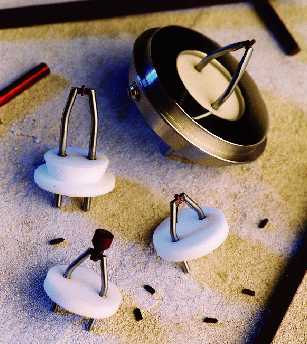
LaB6 and CeB6 cathodes are ideal for many small spot
size applications such as SEM, TEM, surface analysis and metrology, and for high
current applications such as microwave tubes, lithography, electron-beam
welders, X-ray sources and free electron lasers.
Applied Physics Technologies has decades of experience in research,
development, and manufacturing of LaB6 and CeB6 cathodes.
As their agents, Kore can provide the cathodes you need for
replacement, OEM, and custom applications.
Our product flier is available here in PDF format.
A presentation discussing the relative merits of CeBix and LaB6 is also available
in PDF format.
Technical information
Ordering and further information
To place an order, obtain a quote, or ask a question not answered on this
web site please contact Barrie Griffiths at Kore Technology Ltd via email
( ) or other means.
The unique properties of hexaboride crystals provide stable electron-emitting
media with work functions near 2.5 eV. The low work function yields higher
currents at lower cathode temperatures than tungsten, which means greater
brightness (or current at the beam focus) and longer cathode life. Typically,
these cathodes exhibit 10 times the brightness and more than 10 times the
service life of tungsten cathodes. In electron microscope applications, these
characteristics translate to more beam current in a smaller spot at the sample,
improved resolution, and less frequent cathode replacement.
For applications with large beam spot sizes, where large total current and
current density are required, large, flat crystal faces of LaB6 or
CeB6 can be the cathodes of choice. This regime is unsuitable for
point sources such as field emitters, which are unable to provide sufficient
total current, and has been thought of as the realm of the dispenser cathode.
However, LaB6 and CeB6 may be more suitable, being
particularly robust and resistant to chemical poisoning. They have modest vacuum
requirements and long shelf life, and need only be brought up to operating
temperature to provide emission, eliminating the activation procedure required
of dispenser cathodes. They can provide long-term, stable operation at current
densities up to 50 A/cm2, and may be fabricated in a variety of
shapes and with many different heating and mounting configurations.
LaB6 and CeB6 are the materials of choice for high
current cathodes in a variety of advanced and custom applications.
The performance and lifetime of the hexaboride cathode are determined by
several factors: vacuum level, cathode temperature, impurity level, crystal
orientation, tip shape, and mount design. Vacuum requirements are more stringent
for hexaboride emitters than for tungsten in order to minimize carbon
contamination. In laboratory tests, CeB6 has proven to be more
resistant to the negative impact of carbon contamination than LaB6,
which gives it an edge in potential cathode lifetime.

Excessive operating temperatures accelerate evaporation, thus decreasing the
life of the cathode. Care must be taken to properly optimize cathode temperature
to obtain the required emission without overheating the crystal. CeB6
has another advantage over LaB6 relating to lifetime: its evaporation rate at
normal operating temperatures near 1800 K is lower than that of LaB6
(See graph). So long as care is taken to operate the cathode below 1850 K, CeB
6 should maintain an optimum tip shape longer, and therefore last
longer.
Every cathode is burned in under vacuum to precise temperature
specifications, and the corresponding current and voltage data is shipped with
the cathode.
A comparison of electron emission characteristics of LaB6,
CeB6 and tungsten at typical operating temperatures.
|
CeB6
<100> |
LaB6
<100> |
Tungsten
Filament |
| Brightness (A cm-2 sr-1) |
107 |
107 |
106
|
Short-term beam current stability
(%RMS) |
<1 |
<1 |
<1 |
| Typical service life (hr) |
1,500+ |
1000+ |
30-100 |
| Operating vacuum (torr) |
10-7 |
10-7 |
10-5
|
| Work function (eV) |
~2.5 |
~2.5 |
4.5 |
| Evaporation rate (g cm-2 sec-1) |
1.6 x 10⁻⁹
|
2.2 x 10⁻⁹
|
NA |
Impurities in the crystal will
reduce both brightness and lifetime of the emitter because impurities increase
both work function and volatility. We grow and fabricate our own high quality,
single-crystal materials using a well-defined process called 'Inert Gas Arc
Float Zone Refining.' An electric arc melts a pressed-powder stick of LaB6 or
CeB6 in a controlled atmosphere of inert gas, allowing the liquid-phase zone to
freeze onto a selected-orientation seed crystal as the arc is moved along the
stick. The finished crystal assumes the desired orientation of the seed with
less than 30 parts per million by weight metal impurities. Correct melt zone
temperature and process speed minimize excessive boron evaporation to achieve
the optimum ratio of metal to boron atoms in the grown crystal.
Crystal orientation can be selected to match the cathode design or
application. For electron microscopy, the <100> orientation is most
desirable due to its brightness and crystal plane symmetry about the optical
axis. As the cathode ages, the plane symmetry ensures an even evaporation rate
relative to the axis, maintaining a centered, flat emitting surface (See
figure). Also, the emission patterns from the symmetric crystal planes will
remain consistent as they become more exposed by evaporation, contributing to a
brighter beam spot.
The design of the cathode tip is critical for maximum lifetime and optimum
performance. Tip design must also match the specific application's requirements
for beam current, spot size, and brightness. For electron microscopy, a conical
tip with a flat emitting surface at the apex has proven to be the optimum
design.
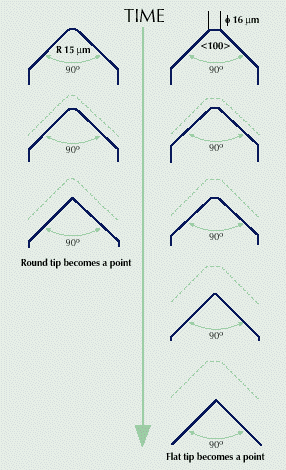
As material is lost over time, the tip shape changes.When the tip becomes
pointed, the cathode reaches the end of its useful life.
With the flat-tipped cone design, changes in both cone angle and flat
diameter affect emission characteristics. In general, the small cone angle
(60°) results in higher brightness, but a larger angle (90°) provides
longer life and easier alignment. Small flat diameters also result in higher
brightness plus a smaller source size, but larger flats provide longer lifetimes
and more beam current.
These trends allow us to tailor our cathodes to the requirements of
practically all thermionic cathode applications. For example, SEM and most
transmission electron microscope (TEM) applications are best served by a 90°
cone angle and a 16 µm flat tip. This combination provides high
brightness, a moderate source size, and very good lifetime. High resolution TEMs
require a 60° cone and a 5 µm flat tip for very high brightness and a
small source size.
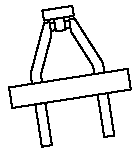
In applications requiring high total current in a large beam spot, a <310> oriented crystal
in a 'top hat' configuration may be preferred, providing a slightly lower work function
and large emitting surface. We excel at developing specialized cathodes for custom
applications and research purposes. Contact us for your custom cathode needs.
The cathode's mount design has a significant impact on performance. The
design must be simple, durable and precise. It must resist any movement of the
crystal, despite the high operating temperatures, yet be easy to install and
align. We feel we employ the best mount design in the industry, the Mini Vogel
Mount.

In 1988, FEI of Hillsboro, Oregon introduced the Mini Vogel Mount (MVM) to
provide the benefits of the original Vogel mount in a smaller, simpler, and more
elegant design. Twin posts are rigidly fixed in a thick ceramic base, and bent
towards the center in an inverted 'V'. The posts are made of a molybdenum-
rhenium alloy that maintains a high modulus of elasticity even at high
temperatures. The posts are spread slightly during assembly to allow placement
of small pyrolytic graphite blocks between the crystal and posts. The blocks act
as resistive heaters, and help thermally isolate the hot crystal from the highly
conductive posts. When the compressive force of the posts is released, the
crystal is held with strength and precision. The clamping force of the posts
will remain near 5,000 psi for the life of the cathode.
The structure of the MVM is amazingly robust, sustaining reasonable impact
without deviating from structural specifications. Because the graphite pads
shield evaporation of the crystal in the direction of the clamping force, the
emitter crystal can be fully utilized without degradation of the mount.
Structural failure of the MVM is not a concern when the cathode is operated
within the correct temperature and pressure range. Typically, the beam stability
of the Mini Vogel Mount cathode exceeds the specifications of the system in
which it runs.
Top
Last updated: 18:30 03/02/2016
© Kore Technology Limited 2014