4GHz time-to-digital converter (TDC)
Kore is pleased to announce our new 4GHz time-to-digital converter (TDC) product for 2010. This timing unit with 250ps capability is the product of a three year development programme and replaces our older 2ns TDC. The new TDC will feature in all future Kore products for time-of-flight mass spectrometry.
As with our previous 2ns TDC, we are offering our new TDC as a stand-alone product for researchers who are building their own TOF experiments and who are looking to configure their equipment with a high performance timing unit.
We also offer to bundle the TDC with a data acquisition computer running GRAMS/AI - a general spectroscopy program from Thermo Galactic for which Kore has written time- of-flight mass spectrometry 'extensions'. With this bundle, a user can add the ability to acquire and manipulate time-of-flight mass spectrometry data to their instrumentation, without needing to write their own data acquisition software.
4GHz Time-to-Digital Converter (TDC)

Introduction
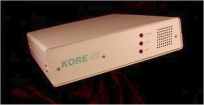
The Kore 4GHz time-to-digital converter (TDC) is new for 2010 and is a compact, bench-top timing unit designed to record a fast stream of event times relative to a single start event (at time=0). It performs this task with a timing resolution of 0.25 ns with minimal dead time, high data rates and the ability to repeat the experiment at very high repetition rates. These features make the unit ideal for use in Time-of-Flight (TOF) mass spectrometry applications. In such an application, the unit issues or receives a cycle start signal at pre-set intervals and waits to receive timing pulses from an ion detector. The pulse times are recorded, buffered and streamed to the PC via a standard USB 2.0 serial interface. Here the standard driver software may process them to spectra 'live', or stream them to the hard disk for more flexible processing options.
This product on its own, without the data acquisition system and software, is suited to engineers with experience of integrating instrument systems. Users with little or no programming experience are advised to ask Kore about the extended data package with a Kore data acquisition computer, GRAMS /AI and Kore TOF acquisition software.
Key Features
- 0.25ns timing resolution
- Maximum burst rate of 2 GHz
- Very high sustained count rate
- Internal or external 'start' triggers
- Fast multiple-experiment control implemented in hardware
- Independent mains-powered case (optional 1U rack mount case) with easy interfacing to a PC via a standard USB 2.0 interface.
- Efficient, interrupt-driven drivers allow the PC to continue working (e.g. simultaneous data processing of data stream)
- Software configurable input levels and input edge polarity for maximum flexibility
- Rich array of driver functions and utilities specifically aimed at TOFMS
- Backed by Kore's extensive knowledge of TOFMS design (for those who have this application in mind)
- Optional Grams/AI package for data collection, plotting, data-management etc customised by Kore for use with the TDC
Detailed TDC Specification
Deliverables
- Kore 4GHz TDC bench top unit
- Mains cable suitable for country of operation
- Kore 4GHz TDC manual (printed version)
- USB 2.0 cable
- CD with TDC manual, data collection utilities 1
Note 1: The data collection utilities are launched from the command line with parameters taken from a simple text file. They can be used for collecting time histograms, collecting time-stamp list-files and monitoring count-rates within a pair of regions of interest for diagnostic purposes. They display windows during execution to show experiment progress. A complete data system might have in addition (a) a graphical user interface to assist in selecting experimental parameters (b) software to process the data and display the result in the form of plots or images. These facilities can be added by the user; the utilities have been designed to make this as easy as possible. Alternatively, the optional Grams/AI and extensions may be purchased.
4GHz Time-to-Digital Converter (TDC) and Time-of-Flight Mass Spectrometry Data Acquisition System
Introduction
Our new 4GHz TDC can be purchased together with a data acquisition system running GRAMS/AI with Kore TOF Mass Spectral 'extensions'. Such a package would be of use to researchers who are building TOF-MS apparatus or have existing equipment and would like to purchase a complete TOF data acquisition / data plotting system.
The Kore 4GHz time-to-digital converter (TDC) is new for 2010, and is a compact, bench-top timing unit designed to record a fast stream of event times relative to a single start event (at time=0). It performs this task with a timing resolution of 0.25 ns with minimal dead time, high data rates and the ability to repeat the experiment at very high repetition rates. These features make the unit ideal for use in Time-of-Flight (TOF) mass spectrometry applications. In such an application, the unit issues or receives a cycle start signal at pre-set intervals and waits to receive timing pulses from an ion detector. The pulse times are recorded, buffered and streamed to the PC via a standard USB 2.0 serial interface. Here the standard driver software may process them to spectra 'live', or stream them to the hard disk for more flexible processing options.
GRAMS/AI from Thermo Galactic is a general spectroscopy software suite. Kore has been using the GRAMS platform successfully for many years in its instrumentation, and has written what we term 'mass spectral extensions' specifically for the case of time-of- flight spectrometry.
A researcher would use the TDC's start signal to trigger various units in the apparatus, and would take the detector output signal to the TDC signal input. The researcher would then have 250ps timing accuracy up to 4.2ms (maximum cycle length) combined with full data acquisition and replotting facilities.
Key Features
- 0.25ns timing resolution
- Maximum burst rate of 2 GHz
- Very high sustained count rate
- Internal or external 'start' triggers
- Fast multiple-experiment control implemented in hardware
- Independent mains-powered case (optional 1U rack mount case) with easy interfacing to a PC via a standard USB 2.0 interface.
- Efficient, interrupt-driven drivers allow the PC to continue working (e.g. simultaneous data processing of data stream)
- Software configurable input levels and input edge polarity for maximum flexibility
- Rich array of driver functions and utilities specifically aimed at TOFMS
- Backed by Kore's extensive knowledge of TOFMS design (for those who have this application in mind)
- Optional Grams/AI package for data collection, plotting, data-management etc customised by Kore for use with the TDC
Detailed TDC Specification
Key Features of GRAMS/AI and Kore Mass Spectral Extensions
- Kore extensions to GRAMS/AI simplify data collection using the Kore TDC. All collection parameters are set up via standard Windows-style dialogue boxes
- Time data can be converted automatically to mass data with Kore's conversion program. This has the advantage of producing mass spectra with values at equally spaced mass intervals (user selectable) that preserve the exact number of counts in the original data
- The equally spaced mass intervals allow the full range of GRAMS/AI processing routines to be used subsequently
- GRAMS/AI features a full set of data manipulation tools
- User-specific tools can be created by the user and placed as icons on the toolbar
- The new AI version introduces many improvements including an enhanced user interface and a collection of updated processing routines based on Microsoft's ActiveX technology
- The ExcelExchange module allows seamless transfer of data between GRAMS/AI spectral data files and Microsoft Excel worksheets. Data can be easily transferred in both directions: from a GRAMS data file into an Excel worksheet and from a worksheet to a data file.
- Spectral DB provides a data management tool for organising spectra and chromatograms into a simple, searchable database
- Spectral ID provides a comprehensive search tool. Spectral pattern matching or "library searching" is one of the most efficient, effective methods for qualitative identification of compounds using Mass Spectrometry
- Handles all types of spectral and chromatographic data from virtually any analytical instrument
- The GRAMS Suite also supports a number of general-purpose data formats such as SPC, ASCII, JCAMP, and AnDI/NetCDF
- For storing data, the GRAMS Suite utilizes the universal SPC file format enabling scientists to share data with colleagues easily.
- For more details of the GRAMS/AI software, please click here
Deliverables
- Kore 4GHz TDC bench top unit
- Mains cable suitable for country of operation
- Kore 4GHz TDC manual (printed version)
- USB 2.0 cable
- CD with TDC manual, data collection utilities 2
- Data acquisition computer, minimum specification dual core processor, 1Gb memory, 160Gb hard drive, DVD-writer drive (CD RW), 19" TFT LCD monitor, USB 2.0 port(s); 10/100 Ethernet LAN, Windows operating system, keyboard, mouse
- GRAMS/AI spectroscopy suite from Thermo Galactic. With CD user book
- Kore mass spectral extensions
Note 2: The data collection utilities are launched from the command line with parameters taken from a simple text file. They can be used for collecting time histograms, collecting time-stamp list-files and monitoring count- rates within a pair of regions of interest for diagnostic purposes. They display windows during execution to show experiment progress. A complete data system might have in addition (a) a graphical user interface to assist in selecting experimental parameters (b) software to process the data and display the result in the form of plots or images. These facilities can be added by the user; the utilities have been designed to make this as easy as possible. Alternatively, the optional Grams/AI and extensions may be purchased.
Top
4GHz time-to-digital converter (TDC) specifications
| Timing resolution | 0.25ns |
| Number of hits per cycle | Unlimited |
| Maximum burst count rate | 2 GHz |
| Full speed front end FIFO depth | 8192 frames of 4ns |
| Maximum sustained count rate | >17,000,000 counts/s (Theoretical) >4,000,000 counts/s (Measured 1) |
| Maximum time stamp value | 0xFFFEFF ~4.2 millisec |
| Triggering modes | Fixed frequency free-running OR External Start trigger |
| Max cycle repetition rate | ≥ 1MHz (hardware)
200 kHz (current software limit) |
| Min cycle repetition rate (free running) | ≤20 Hz (hardware)
500 Hz (current software limit) |
| Min cycle repetition rate (External start trigger) | Unlimited |
| Number of cycles per experiment (on board counter) | 1 to 4x10⁹ |
| Cycle counter reset time | <1µs |
| Dead time between cycles | 36ns at cycle start and 4ns at end |
| Timing precision | <470ps (1 hour measurement of peak at 500µs) estimated as 280ps internal trigger & 380 ps external trigger 2 ) |
| Start/Stop input range | -5V to +5V 3 |
| Start/Stop input threshold range | -2.5V to +2.5V (positive or negative timing edges selectable in software) |
| Start/Stop input termination (jumper selectable) | 50Ohm to ground (Normal) OR
50Ohm to -2V (ECL) |
| PC interface | USB 2.0 |
| Power requirement (typical for board) | +5V 730mA and -5.2V 65mA |
| Bench-top case dimensions | 280 x 300 x 70 mm |
| Bench-top power requirement | 230/115 VAC 50/60Hz 7watt |
| Software requirement | Windows XP or later |
Note 1: Using the standard motherboard-based USB interface on an inexpensive general purpose PC purchased early 2009 [Pentium E5300 Dual Core 2.6 GHz with 1G RAM running WinXP svpk3. Device manager reports hub as "Intel 82801G (ICH7 Family) USB2 Enhanced Host Controller - 27CC"]
Note 2: A measurement was made of the pulse width from a digital oscilloscope 'Cal' output, presumably crystal controlled, but no specification was available for pulse-width jitter. The TDC was triggered on each cycle by the leading edge of the pulse and the trailing edge was interpreted as a stop value. The histogram from a 1 hour measurement was fitted with a Gaussian curve, which had a full width half maximum of 470 ps. The leading edge will be subject to 250 ps of jitter because the 'scope is not synchronised to the TDC. This element of the jitter would be absent in an experiment using internal cycle trigger. For estimation purposes it was assumed that the 'scope and intrinsic TDC jitter were of similar size (both crystal controlled clocks) and that the various elements combined in quadrature (sum equals square-root of sum of squares).
Note 3: The input comparator has protection diodes that limit the differential input voltage. This means as the difference between the input and the threshold exceeds about 1.25V a little more current will be drawn. This causes no damage but may give rise to double pulsing under some circumstances.
Top
Last updated: 14:15 12/03/2014
© Kore Technology Limited 2014