Townsend number (E/n) - Soft Ionisation vs. Fragmentation
The value of E/n within the PTR reactor is important (where E is the voltage gradient per cm in the PTR, and n is the number of molecules per cc). This value determines how soft the ionisation will be. If E/n is high, the molecule will undergo energetic collisions that will cause it to fragment. If E/n is low the molecule is drawn through the reactor more gently. At low E/n, depending upon the water content, it is possible for water clusters to form in the PTR. This is not necessarily a problem provided that the analyte of interest has a higher proton affinity than the water dimer (~808 kJ/mol) A good example of this is shown below for the molecule tri ethyl phoshate. TEP has a proton affinity of 909kJ/mol.

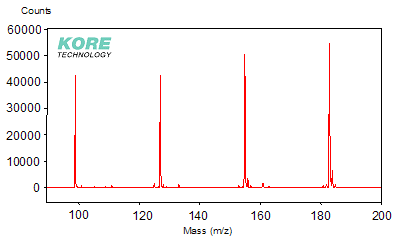
Tri-Ethyl Phosphate at high E/n (~260 Townsend)
Loss of ethyl groups (-28 mass units)
Note protonated molecular ion at mass 182 has low intensity
Reduced E/n value (~195 Townsend)
Protonated molecular ion is now the base peak, but still significant amount of fragmentation
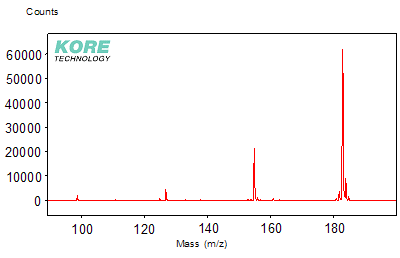
E/n value reduced further (~130 Townsend)
Note that the protonated molecular ion is now the base peak in this mass range
Top
Last updated: 17:43 28/01/2014
© Kore Technology Limited 2014